Peter Nientied
La Siberia (Badajoz)
When I started reading about España vacía, I came across expressions such as “demographic desert”, “Lapland of Spain”, and “Siberia of Spain”. Later I discovered that there is actually a comarca called La Siberia, and I decided to explore this region in the east of the province of Badajoz, in Extremadura.
How the comarca got its name is not exactly known. One explanation refers to the construction of the railway at the end of the 19th century. Workers had to go to what was considered a remote and desolate area, comparable to the situation of labourers sent to Siberia in Russia. However, no one knows for sure.1)
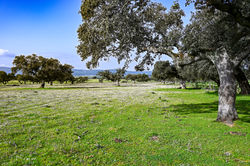
La Siberia is a comarca whose northern part consists of hills and mountains (up to about 800 metres), forests and small villages. The central and southern parts are more open countryside with sheep, holm oaks and eucalyptus trees, some small towns and olive groves.
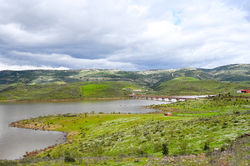
La Siberia includes the recognised Biosfera de La Siberia, which covers 1,488 km², about half of the total area of the comarca (2,943 km²). Nestlé has a large plant within the biosphere area where mineral water is extracted. La Siberia also contains three large embalses (artificial lakes or reservoirs) used for water regulation and electricity generation. About 10% of the total area of La Siberia consists of water surfaces. In addition, 1,479 km² is cultivated land, mainly grassland.

Click to enlarge. Source: Google Maps
Click, full screen with upper left arrow.
 |  |  |
|---|---|---|
 |  |  |
 |  |  |
 |  |  |
 |  |  |
 |
The number of residents in La Siberia is around 20,679 (depending on the administrative boundaries used), which means far fewer than 10 inhabitants per km². The north is very sparsely populated, while the centre and south have somewhat more inhabitants. In 1950 the population was between 45,000 and 48,000. Between 1960 and 1970 about a quarter of the population left for regions with emerging industries.
The main town, Herrera del Duque, used to be the economic engine of La Siberia, but between 1960 and 1970 its population fell from 8,632 to 4,915 — a true exodus. Today it has about 3,400 inhabitants.
The number of inhabitants is expected to decline further, mainly because the current population is relatively old on average. Economic participation is low, and the agricultural sector (which employs 31% of the active population) is likely to shrink due to a lack of successors. In sectors such as construction and health care there are job opportunities. The region is investing in rural tourism, although it lacks major or widely known attractions.